

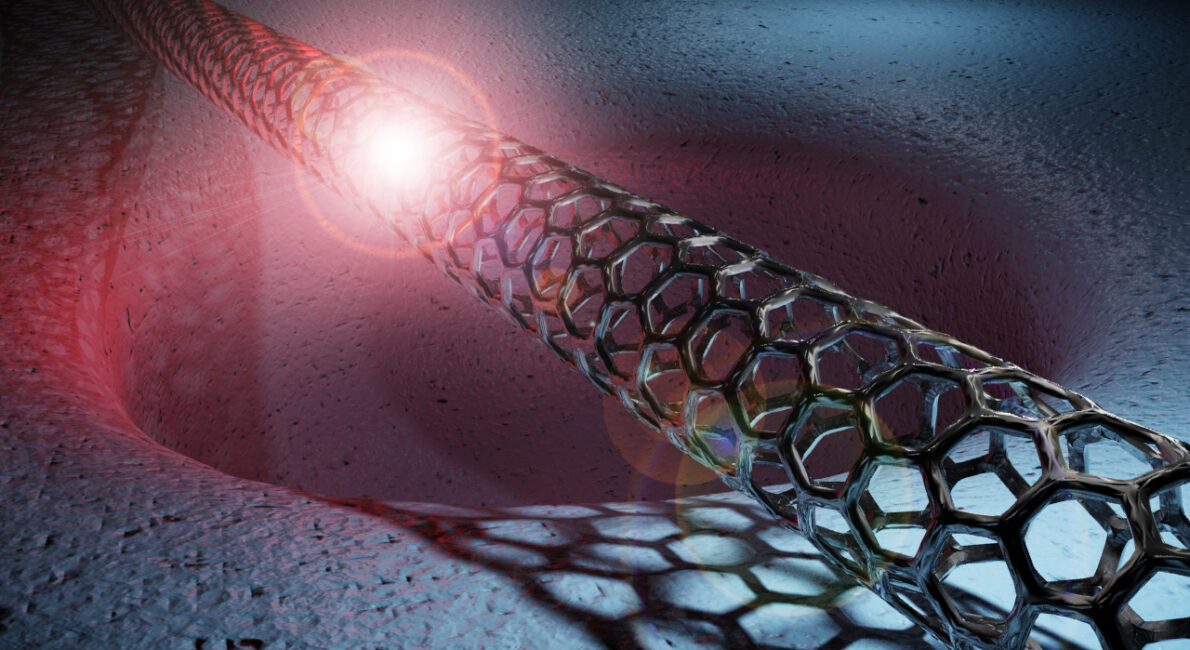
Carbon nanotubes play an important role. Image by Christoph Hohmann, MCQST.
Researchers at LMU Munich and collaborators have taken a major step toward practical quantum networks by generating single photons at room temperature and telecom wavelengths with enhanced indistinguishability.
Whereas today’s internet relies on pulses of billions of photons, quantum networks need identical single photons to distribute quantum features such as entanglement. Until now, this has required cryogenic cooling, making real-world deployment impractical.
The team used chemically modified carbon nanotubes as single-photon emitters and placed them in a fiber-based microcavity. While nanotube photons normally dephase rapidly at room temperature, the cavity filters and stabilizes them, forcing photons to align and greatly improving their coherence. Tests confirmed enhanced indistinguishability through the Hong–Ou–Mandel effect, which provides clear evidence of quantum interference.
By achieving single, telecom-ready photons with enhanced indistinguishability without the need for cryogenics, this work overcomes two major barriers to scalable quantum communication. The approach could be extended to other emitters, paving the way for room-temperature quantum light sources that are compatible with today’s fiber networks.
Get the details and a link to the white paper in the case story.
Want more information like this? Sign up for our newsletter.