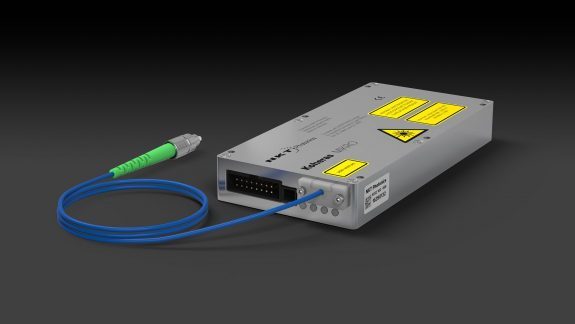
Distributed Acoustic Sensing (DAS) turns subsea fiber-optic cables into long, continuous sensor arrays that can detect vibration and acoustic activity over many kilometers. By sending coherent laser pulses into the fiber and analyzing the backscattered light, DAS enables real-time monitoring of subsea infrastructure and the surrounding environment. Laser stability, narrow linewidth, and low phase noise are key factors that determine sensitivity, range, and long-term measurement reliability.
Subsea sensing for offshore infrastructure monitoring
Subsea infrastructure is the backbone of offshore energy and communications, but monitoring it has always been challenging due to distance, access, and cost.
Subsea sensing refers to the measurement of physical conditions and events in the water, on the seabed, or beneath it. It helps operators understand what is happening around subsea assets (for example, pipelines, wells, and subsea power/telecom cables), as well as environmental and geophysical activity such as currents, sediment movement, and seismicity.
With DAS, subsea sensing often means using an optical fiber as a long, continuous sensor that provides coverage over many kilometers, rather than relying on a limited number of discrete sensor locations.
How Distributed Acoustic Sensing works
Distributed Acoustic Sensing (DAS) turns a standard fiber-optic cable into a dense array of “virtual sensors.” An interrogator sends short, coherent laser pulses into the fiber and measures the tiny fraction of light that is naturally backscattered from microscopic variations in the glass.
Dynamic strain and vibration along the cable slightly change the optical phase of that backscattered light. Because the return signal is time-resolved, the system can map these phase changes to specific positions along the fiber, producing a distributed measurement of vibration and acoustic activity versus distance and time. The spatial resolution and range are determined by the interrogation scheme and system design.
Why DAS is important for subsea monitoring
Subsea systems are long, remote, and expensive to equip with conventional point sensors, so the main advantage of DAS is continuous coverage. In many cases, the sensing fiber is already part of the installed infrastructure, reducing the need for additional subsea sensor hardware.
With a single fiber route, operators can monitor large areas in real time. This enables early detection of abnormal events such as third-party interference near a cable route, impacts, signs of anchor dragging, or changes in vibration behavior. DAS is also valuable for geophysical and environmental monitoring when the fiber is well coupled to the seabed.
Laser choice is more than just wavelength
DAS interrogators typically use a single-frequency, narrow-linewidth, low-noise fiber laser, often in the 1550 nm telecom window. The wavelength is chosen largely because fiber attenuation is low and components are readily available. However, performance is driven by more than wavelength.
The laser’s coherence and phase/frequency noise directly influence sensitivity, achievable range, and susceptibility to measurement artifacts in phase-sensitive detection. In practical terms, stability, narrow linewidth, and coherence help the interrogator resolve smaller signals over longer distances, while sufficient optical power supports strong signal levels from the backscattered light.
What makes Koheras MIKRO different in this application
In DAS, the laser is not just a light source – it defines the quality of the phase measurement.
A highly stable, low-noise single-frequency laser, such as the Koheras MIKRO E15, helps lower the system noise floor and improves the ability to resolve small signals. This is especially important when pushing for longer reach, finer resolution, or operation in noisy real-world subsea environments.

A mode-hop-free, ultra-stable source also improves repeatability and reduces drift-related interruptions, which is critical for “always-on” monitoring deployments.
From a system integration perspective, an OEM-ready laser module with built-in control and monitoring can simplify design and support robust operation in deployed DAS interrogators. This is particularly true compared to solutions that are harder to stabilize in day-to-day operation.
Design DAS as a system
DAS performance is a system-level outcome: it depends on cable type, installation method, coupling to the seabed, interrogation approach, and signal processing and classification – not just the laser.
That said, for phase-sensitive sensing, the laser remains one of the key enabling components that determines how far and how accurately a DAS system can “listen” along a subsea fiber, and how reliably it can do so over long durations.
For best results, specify and optimize the laser together with the fiber, interrogator, and analytics as one end-to-end sensing chain.
It is also worth noting that fiber-optic sensing is not limited to acoustics – distributed temperature and strain modalities (DTS/DSS) can complement DAS in a subsea monitoring strategy. Contact us to learn how laser choice impacts DAS performance – and how the right source can unlock longer reach and higher sensitivity in subsea sensing.
Contact us to learn how laser choice impacts DAS performance – and how the right source can unlock longer reach and higher sensitivity in subsea sensing.